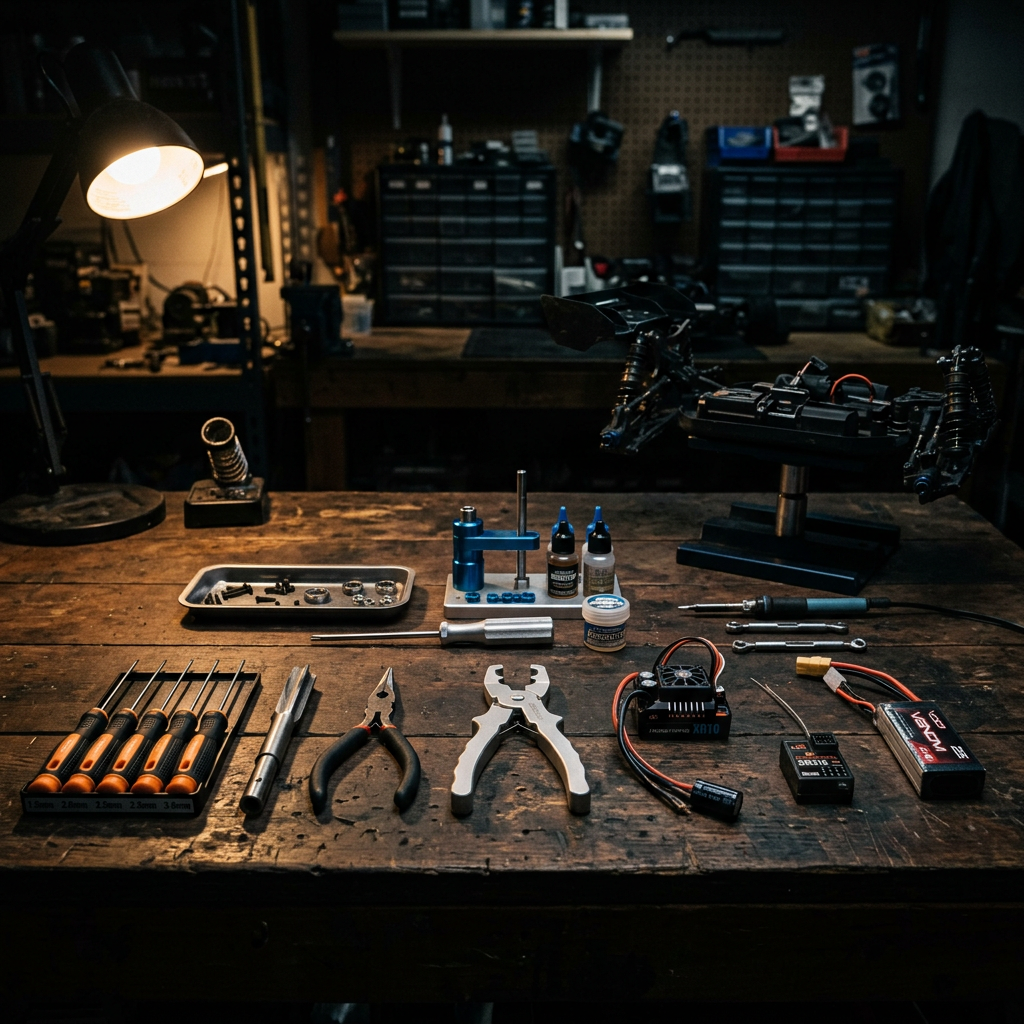
The RC Car Tools You Actually Need (Tested by a Racer)
You can drop $800 on a kit car and strip every screw on it with the wrong drivers. You can glue a perfect set of tires and watch them delaminate mid-race because you grabbed hardware store CA. Tools aren't exciting until the wrong ones cost you a race, a motor, or a battery pack. After a decade of racing and wrenching, these are the 10 tools I actually reach for every single session. No filler. No fluff. Updated for 2026 with different options on every category that matters.
Affiliate Disclosure: Links in this article are affiliate links across Amazon, AMain Hobbies, AliExpress, and eBay. Purchases made through them support Netcruzer content at no extra cost to you. Thank you.
Metric Hex Drivers — The Single Most Important Tool You Own
Read this section before anything else. Virtually every modern RC car is assembled with metric hex screws. Strip one with a worn or ill-fitting driver and you're facing a drill-out, a parts bin rummage, or a race DNF. Hardened, precision-ground tips are not optional.
GOOD — Dynamite Machined Metric Hex Driver Set (DYN2904)
Anodized aluminum handles, hardened steel shafts, flat-sided so they don't roll off the bench. Replacement tips available in all sizes. A basic set of decent drivers, Includes 1.5mm, 2.0mm, and 2.5mm.
BEST — MIP Gen 2 Metric Hex Driver Set (MIP9602) — 1.5/2.0/2.5mm
The gold standard. Made in the USA since 1975. Tolerances held within 20 microns, black oxide coated, laser-etched size markings, color-coded rings for instant identification. If you race seriously, these are the ones. Add MIP9211 (3.0mm) separately if you run larger scale.
COMPACT — Dynamite 8-in-1 Multi Hex Wrench Kit (DYN2950) — The Space-Saver
Seven popular hex sizes with ¼" drive tips that store inside the handle. Works with any cordless drill for speed-building. Best compact pit bag tool if you want one handle that covers everything.
NETCRUZER NOTES: I ran Dynamite 8-in-1 for years and still keep a set as bench backups. The MIP is what I reach for on race day. The hardened tip precision on Loctite'd metal-threaded screws is genuinely night and day. The Dynamite Multi-Driver lives in my track bag. Having every size in one handle at the pits is just smart packing.
BONUS - Ball-End Hex Drivers — Your Chassis Access Pass
Modern compact buggies, laydown transmission designs, and tight battery trays make straight hex drivers useless in certain spots. A ball-end driver lets you work at up to 25–30 degrees off-axis — essential for screws buried behind chassis braces or inside shock towers.
NETCRUZER NOTES: Buy a 2mm ball end and you'll wonder how you lived without it.
RC Tire Glue — Get a Flexible Formula or Pay for It Later
Hardware store super glue is not RC tire glue. The wrong CA cracks under tire flex, delaminates at speed, and fights your tire's natural sidewall movement instead of working with it.
Pro-Line Pro-Bond Tire Glue (PRO6031-00)
NETCRUZER NOTES: My specific recommendation is Pro-Line Pro-Bond, and here's why it beats everything else: the formula cures with flexibility. That matters not just for keeping tires on rims, but for sidewall tuning. Experienced racers apply a thin bead of Pro-Line along the outside of tire sidewalls to tune cornering stiffness and feel — that technique only works with a glue that stays slightly pliable after curing. Brittle glue just cracks and peels. The applicator tip system is also the best I've used — the yellow reusable tips give precise bead placement without clogging. Get extra tips and budget one per set of tires.
RC Tool Bag / Storage System — Organize Once, Race Better Every Night
A disorganized pit box is a slow pit box. The right storage system means you spend race night actually racing, not hunting for your 2.5mm driver under a pile of spare bodies.
COMPACT — Soft Shell Makeup Cases
The best-kept secret in RC organization. Makeup cases and zipper pouches come in exactly the right sizes for tool organization, have multiple compartments, and cost a fraction of branded RC cases. Perfect for a track-side kit you clip to your pit bag.
HEAVY DUTY — Husky Portable Tool Chests with Modular Bins
For the serious home shop or large pit cart setup. The 2-drawer unit is perfect — screws, hop-ups, and hardware organized by vehicle or category. Stack the modular bin units and you have a system, not a pile.
NETCRUZER NOTES: I use soft makeup cases for compact track-day kits — genuinely the best-kept secret in RC organization and nobody talks about it. For home shop, Husky modular bins changed my parts-finding life. Label each bin by car or component type and you'll never lose a servo horn again.
Body Reamer + Curved Scissors — Clean Holes, Zero Cracked Bodies
Anyone who's tried to make a body post hole with a screwdriver tip knows the damage — cracked polycarbonate, ragged edges, bodies that look like they lost a fight with a can opener. A proper body reamer cuts clean, precise holes up to 14mm in seconds. Always get a kit with curved lexan scissors — trimming polycarbonate with straight scissors is a chore and the curved blade follows body lines naturally.
HobbyPark 0-14mm Body Reamer + Curved Scissors (Black)
NETCRUZER NOTES: One of the cheapest tools on this list and one of the most impactful for the finished look of your car. Get the combo with curved scissors. You'll reach for them every time you mount a new body.
Locking Hemostat Forceps — Fingers Where Fingers Can't Go
The most underrated tool in RC. Locking hemostats are surgical-grade forceps that grab and hold small screws, nuts, e-clips, and pins in spots your fingers physically cannot reach — inside a shock tower, under a gearbox, in a narrow battery tray. The locking mechanism means you don't have to squeeze while you work. Get a set with both straight and curved — the curved ones are invaluable for reaching around chassis braces.
Straight + Curved Locking Hemostat Set
NETCRUZER NOTES: I cannot count how many e-clips or nuts have launched into the carpet without locking hemostats. They're a few dollars, take up almost no space, and are worth their weight in gold. Get the curved ones, you'll know exactly why the first time you need to reach around an A-arm brace at arm's length.
Camber Gauge and Ride Height Gauge — Dial In or Drive Blind
Camber affects your tire contact patch, steering response, and stability under braking and cornering. Even experienced drivers cannot accurately set camber by eye. A crash that shifts your camber one degree will have you chasing a handling problem for three heats without a gauge to catch it. Also consider buying an analog Ride Height gauge. A difference of a few mm front to rear really can affect how your car reacts on track and after landing jumps. Those two gauges help with your quick check car setups. Your eyeballs are not good enough, believe me I've tried!
GOOD — RPM Precision Camber Gauge (RPM70992) — 1/10 and 1/8 Scale
Under $10, accurate to within 1 degree, fits 1/10 and 1/8 scale. The budget classic that just works.
BETTER — Muchmore / JConcepts Aluminum Camber Gauge
Aluminum construction, pivot arm with lock screw, graduated scale. The community standard recommendation for club-level racers who want real precision.
NETCRUZER NOTES: After any crash, the first thing I check with the camber gauge is front left and right. That's almost always where an impact shows up first. Having a documented pre-race setup reference makes it obvious immediately instead of chasing a mystery handling problem for three heats.
Soldering Iron + Good Solder — Stop Fearing Connectors
Soldering is not hard. Bad tools make it hard. A proper iron with temperature control makes clean connector swaps, motor leads, and ESC wiring fast and repeatable. The first time you avoid a shop soldering fee, this tool pays for itself.
DESKTOP — TrakPower TK950 / TK955 Soldering Station
The RC hobby bench standard. Stable temperature, fast heat-up, replaceable tips. The TK950 (60W) handles everything from 18AWG signal wire to XT90 battery connectors. If you have a dedicated RC workbench, this is the right tool.
PORTABLE — C245 CARTRIDGE — AWGEM SJ1 with C245K Tip (2 Second Heat-Up)
This is the next level. The AWGEM SJ1 runs the JBC C245 cartridge format — the same platform used by professional electronics repair stations at a fraction of the price. 100W, 2-second heat-up to full soldering temperature, intelligent auto-temperature adjustment based on tip contact size, gravity-sensing auto-sleep, and C245/C470 tip compatibility. In my testing it's a legitimately excellent iron. Needs a 65W USB-C PD supply — 20V/3.25A is the sweet spot.
THE SOLDER — 60/40 Rosin Core, 0.8mm Diameter
For RC use — connector swaps, motor leads, ESC wiring — you want 60/40 rosin core at 0.8mm. It melts at lower temperature than lead-free, flows better, and makes joints that are easy to inspect visually. If you've struggled with soldering before, switching to the right solder is often more impactful than upgrading the iron.
NETCRUZER NOTES: I run a TrakPower at the bench and the AWGEM C245 in my track bag. The AWGEM running off a 65W GaN brick is one of the best things to happen to trackside RC repair. Two seconds to full temperature, packs into a pocket, and handles XT60 joints as cleanly as my bench station. Once you use a C245 cartridge iron you will not go back to a standard heating element.
Bottom Line
The tools on this list will outlast a dozen cars and pay for themselves in stripped screws you didn't strip, tires that stayed on the rim when it mattered, and in setups you could quickly check.
📺 Subscribe to Netcruzer on YouTube for weekly videos, race coverage, and gear reviews.